


FE1202—Fibonacci Patterns in Society and Economics
Recursive Growth in Human Achievement
1.0 Overview
Human progress has never followed a straight line. Although the famous Fibonacci sequence originated with a hypothetical rabbit problem, its deeper lesson is not about rabbits—it is about recursive growth. This essay explores the reproduction of human achievement. Every generation inherits knowledge, institutions, technologies, and culture from those before it, then expands that inheritance before passing it forward. Innovation creates new possibilities; those possibilities increase human capability; greater capability creates still more opportunity. Civilization therefore advances through self-building patterns that often resemble, though do not precisely follow, the recursive logic illustrated by the Fibonacci sequence. Recognizing this pattern helps explain why knowledge compounds, why specialization accelerates discovery, why decentralized societies consistently outperform centralized ones, and why the greatest wealth of civilization lies not in what each generation consumes, but in what it contributes to those that follow.
2.0 Human Progress Is Not Linear
History is often presented as a sequence of isolated events or brilliant individuals, but civilization grows very differently. Progress is cumulative. Every generation begins not from scratch, but from the accumulated achievements of countless generations before it.
Language, mathematics, agriculture, writing, metallurgy, engineering, science, law, and commerce did not emerge independently. Each became part of humanity’s inheritance, allowing later generations to build upon foundations they did not have to recreate.
Human progress is therefore better understood as a recursive process than a linear one.
3.0 Beyond the Rabbit Problem
The historical inspiration for this essay comes from Liber Abaci, published by Leonardo of Pisa (Fibonacci) in 1202. Among its many examples was a simple thought experiment describing the reproduction of rabbits. The resulting numerical sequence eventually became known as the Fibonacci sequence.
The rabbits themselves are not the important lesson. The deeper insight is that simple recursive rules can generate remarkably rich patterns over time.
FE1202 does not argue that human civilization literally follows the Fibonacci sequence. Rather, it suggests that many social, economic, and intellectual systems exhibit similar recursive behavior, where each new stage builds upon the accumulated achievements of those before it.
4.0 The Reproduction of Human Achievement
Rabbits reproduce rabbits. Human civilization reproduces human achievement. Every generation inherits an extraordinary collection of ideas, institutions, technologies, infrastructure, artistic expression, scientific understanding, and cultural traditions. Those inheritances are refined, expanded, and transmitted to the next generation. The recursive cycle is remarkably simple:
Inherit → Improve → Transmit
Unlike biological evolution, which depends largely upon genetic inheritance, civilization evolves primarily through the inheritance of knowledge and achievement. That recursive process has continued for thousands of years.
5.0 Can Ideas Have Descendants?
Science writer Matt Ridley famously described innovation as occurring when ideas “have sex.” His central insight is that new ideas rarely appear in complete isolation. Instead, they emerge when existing ideas meet, combine, and produce something entirely new.
FE1202 extends this insight beyond ideas alone, as did Ridley himself. Technologies, institutions, ownership systems, markets, scientific methods, and other forms of human achievement also combine, evolve, and become the foundation for future progress. Civilization advances because each generation inherits an expanding body of achievement, improves upon it, and passes it forward.
Innovation is therefore not merely invention. It is recursive recombination.
6.0 The Geometry of Civilization
Trees branch. Rivers branch. Blood vessels branch. Knowledge branches. Markets branch. Ownership branches. Scientific disciplines branch. Civilizations themselves branch into increasingly specialized systems built upon earlier foundations.
The resulting patterns rarely form perfect Fibonacci sequences, yet they frequently display the same underlying principle: complex structures emerging through repeated local growth rather than centralized design. This is the geometry of civilization.
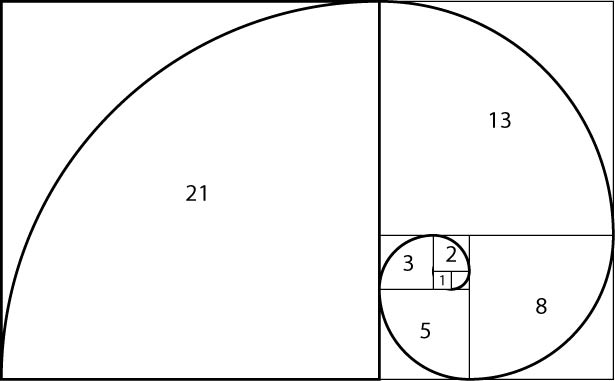
The Geometry of Civilization is not the same as, but similar to, Fibonacci growth.
7.0 Decentralization and Recursive Growth
Recursive growth flourishes where individuals are free to experiment, cooperate, specialize, exchange, and build upon one another’s achievements. Centralized systems often attempt to direct progress according to predetermined plans. Decentralized societies instead allow millions of independent decisions to interact, producing discoveries that no central planner could have anticipated. This helps explain why societies that protect property rights, voluntary exchange, scientific inquiry, and freedom of association have historically generated extraordinary levels of innovation.
Progress is not commanded. It emerges.
8.0 Economics as Accumulated Achievement
Economics is often described as the study of production, consumption, and exchange. Those activities are important, but they are not the whole story. The true engine of long-term prosperity is the accumulation of productive capability. Every invention becomes a tool for future inventors. Every successful business creates opportunities for suppliers, customers, and entirely new industries. Every improvement increases the platform upon which future improvements are built.
Economic growth is therefore recursive. Money, ownership, markets, and institutions all exist to facilitate the accumulation and transmission of human achievement across generations.
9.0 Looking Forward
The publication of Liber Abaci in 1202 transformed European mathematics by introducing a numerical language capable of expressing growth, accumulation, and increasingly complex systems. More than eight centuries later, humanity possesses the computational tools, communication networks, and decentralized technologies needed to understand these same recursive principles in entirely new ways.
The question is no longer whether civilization grows recursively. The question is whether our institutions—including our economic institutions—accurately reflect the geometry of that growth. Understanding the recursive reproduction of human achievement may prove to be one of the most important intellectual foundations for building the next generation of decentralized society.