

FE2—Fibonacci Numbers Versus Terms
Does the Fibonacci Sequence begin with zero, or one? Some people disagree.
0, 1, 1, 2, 3, 5, 8, 13, 21, 34, 55 . . . begins with zero.
1, 1, 2, 3, 5, 8, 13, 21, 34, 55 . . . begins with one.
Mathematicians will usually say it begins with zero, but where do you see a “zero” square in the diagram below? Specifically, a square with zero height and zero width?
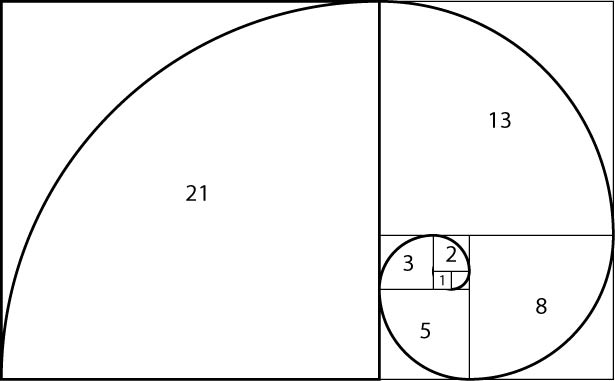
Mathematicians are also comfortable using the word “zeroth” (0th) to describe the position of the first element in the Fibonacci sequence, but that sounds awkward to the rest of us. Perhaps even wrong. U2D2 side-steps the dilemma by choosing two different terminologies. For this website the word term refers exclusively to a zero-based Fibonacci sequence. So zero (0) is the first term in the Fibonacci Sequence, not the zeroth. And since the number one (1) is repeated, that means it is both the 2nd and 3rd terms in the sequence. Likewise, 2 is the 4th term in the sequence and so on.
| Fibonacci Sequence | ||||||||||
|---|---|---|---|---|---|---|---|---|---|---|
| Position in Sequence | 1st | 2nd | 3rd | 4th | 5th | 6th | 7th | 8th | 9th | 10th |
| Term (Begins w/Zero) | 0 | 1 | 1 | 2 | 3 | 5 | 8 | 13 | 21 | 34 |
| Number (Begins w/One) | 1 | 1 | 2 | 3 | 5 | 8 | 13 | 21 | 34 | 55 |
By contrast, Fibonacci numbers in the U2D2 site begin counting at one (1)—not zero (0). So the first Fibonacci number is 1, and since 1 is repeated—and the only such element in the sequence which does repeat—the second Fibonacci number is also 1. Then the third Fibonacci number is 2, etc. Thus if someone asks whether the Fibonacci Sequence begins with zero or one, we can simply say “yes” because it can begin with either zero or one, depending on the context.
Yet another way to refer to Fibonacci elements is to avoid anything related to sequence and simply use their corresponding numeric values. This can be true and accurate independently of where counting begins. Using this method, for example, you could state: “The Fibonacci number (or term) equal to 13…” and avoid anything about where the sequence starts.
Part of the reason for this dilemma is using numbers as names. On a typical number line the numbers and names are the same. The number line of whole numbers contains all positive and negative numbers, plus zero. So when we refer to any element in that number line, there is no confusion. Not so with the Fibonacci Sequence. We have “named” the first term in the Fibonacci Sequence “zero” and the number corresponding with that name is the 0. And the name of the tenth number in the Fibonacci Sequence is 55.
You might ask: Why does this matter? Because sometimes we need to discuss Fibonacci elements by their position in the sequence, but other times we need to discuss them by their numeric values. And when a number is also a name it can get confusing. So in this website we will attempt to achieve consistency using three different identifiers—terms, numbers, and elements.
Because terms depend on both repetition and indexing conventions—such as whether counting begins at zero or one—U2D2 does not use Fibonacci terms as identifiers. Instead, U2D2 uses discrete Fibonacci numbers as webpage and document identifiers. This ensures that each identifier is unique and invariant, even when a value occupies multiple terms within the sequence. By distinguishing terminology in this way and applying it consistently, U2D2 preserves both mathematical correctness and structural integrity across the site.
The Fibonacci encoded URL for this webpage is:
—————————————————————–
0100010001110010010011100100100110100001001100010010011001000001100000101100000101110001010011100010100111000101001110101001101010010011001001011001010000110010010111010100110100100001110000010011010101000110000010110000010001110101000011001001011000001011
—————————————————————–
This is an intentional design choice. Within U2D2, some webpages exist only as encoded addresses, requiring decoding before they can be visited. The presence of an encoded URL here serves as a further indication that navigation within U2D2 is not always obvious, and that discovery sometimes requires deliberate exploration.
Notwithstanding all of the above, FE2 does firmly establish the number 2 as the fourth term in the Fibonacci sequence (0, 1, 1, 2…), while also designating it as the second distinct Fibonacci number (1, 2, 3, 5, 8…) and used as an FE identifier within U2D2.
NOTE: FE2 is an unlisted webpage within the U2D2 website. It is not linked directly from other pages and is intended to be discovered only by those who notice gaps in the numbering and choose to explore. For some website visitors, FE2 will be the first indication that some U2D2 pages are intentionally unlisted and found only through discovery.